
By Kyle Burdick
Often “the test” of what qualifies as good forestry ends at the log truck: meaning how the logging operation was planned and completed. But what about the use of those logs? Should we evaluate their final destinies in the measure of good forestry? I think so. At present, an assessment of supply and demand would suggest there are too many trees in Maine. Of course, there is no such thing as too many trees, but if your job involves the marketing of logs that nobody seems to want, it certainly feels that way.
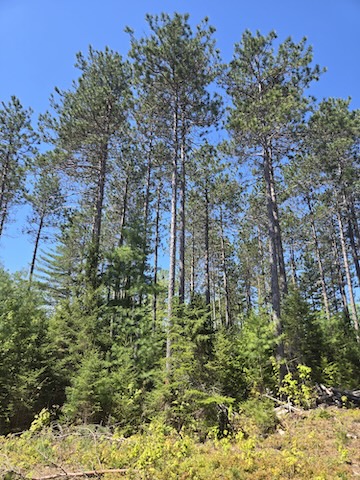
This past summer I executed the single most fulfilling timber harvest of my career as a forester. The harvest took place in the north half of Topsfield, Maine, at my place of work, Baskahegan Company, on what is called the 1934 Burn Road. It’s called that, because, you guessed it, it burned in 1934. What the fire left behind was a stand of fire-origin red pine, a rarity in Maine. Whether due to the intense fire, or glaciers, the soil is exceptionally poor in quality, and the trees are exceptionally slow growing, at least for red pine. At over 90 years old, many trees (even after thinning) have only now grown over 12 inches in diameter. This, with tight growth rings, makes for excellent quality wood to build with. Despite many outstanding qualities, red pine is often discriminated against by many builders, and that translates to low dollar value or no dollars at all.
So why harvest these trees? Certainly, they deserve appreciation for their near century of service. For one thing, yet another forest pest is heading north, causing severe mortality to red pine: red pine scale (Matsucoccus matsumarae). The future is very grim for these trees. The second reason is the forest product. In this case, the harvest was to be made into art — perhaps the most appreciated product humankind has ever produced.
Forest Products as Art
Earlier in the spring of 2025, my former boss Roger Milliken asked me if I had time to work on a special project. He introduced me to his friend Daniel Minter, a distinguished artist with works across the world. Minter composes his work in sculpture, painting, and illustrations, and his work embraces community, ancestry, environment, and Indigenous thinking. Minter was planning an installation involving wood at the Coastal Maine Botanical Gardens in Boothbay. He and Milliken arrived in May, and we drove around looking at various species in different parts of the property. Minter decided on the Burn Road red pine.
The harvest size was measured in the number of logs, not acres. The trees were felled with a chainsaw, bucked in place, and loaded onto a 22-foot equipment trailer with a 45-horsepower tractor. A 40-year-old PTO winch was used to assist in directional felling, but the trees were so close to the road, skidding wasn’t necessary. Baskahegan Company’s summer intern, Alan Chausse, assisted me in the felling and loading. The logs were then driven to the botanical gardens with a Toyota Tundra and delivered in tight quarters a log truck couldn’t have accessed.
While the harvest had all the hallmarks of a low-impact forestry operation, the rewarding part for me was how the trees were going to be used.
The Installation
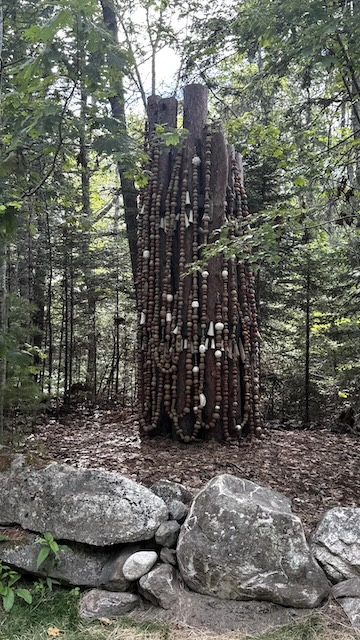
“’In The Voice of Trees’ illustrates an African proverb: sticks in a bundle are unbreakable,” says Minter.
The bundle of logs stands 16 feet high and is bound with strings of clay beads made by community members. The result is stunning. It’s the kind of art that can be universally loved and appreciated, really emphasizing its purpose in community.
Minter says, “They will be bundled together and bound, to represent our bodies, to represent our communities, to represent our ancestors. That we are stronger when we stand together.”
The piece embodies Indigenous philosophy, both in consideration for the land on which the piece sits and also by embracing “Seven-Generation Thinking” — the belief in which one makes decisions with seven future generations in mind.
The artist adds, “I’ve been amazed that people have been so generous — in the giving. It has really been lifting my spirits in this time. I’m benefiting from the medicine. I hope others are as well.”
Redefining Forest Value
I, for one, made good use of this medicine. The forest products industry has been in decline since I graduated college 18 years ago, and it looks like the worst is not over. This work has put “value” into perspective, as well as the role forests play in my life and career. Commodities are all about communities but not in a good way. In commodity production, like timber, it’s been competition for what community can be the poorest and still produce the product. For things like pulp, Maine must compete with poor communities across the globe. Whoever can produce the cheapest, and still function, gets to sell. That’s a game I’m not sure we want to win. Local wood markets may not be able to replace those markets by volume, but perhaps they don’t need to sustain that volume.
There is an ecological reserve just around the corner from the Burn Road harvest site that hasn’t been touched for 100 years. And it’s doing wonderfully without us. It’s cleansed itself from disease and still maintains remarkable diversity.
In The Voice of Trees opened to the public on July 27, 2025, as part of the Indigo Arts Alliance’s Deconstructing the Boundaries program. It will remain as a semi-permanent fixture in the gardens. Please see it, you will be glad you did.
Kyle Burdick is the vice president of Baskahegan Company and has spent his 18-year career managing industry, conservation, and family forest land. He lives in Lee, Maine, and has 60 acres of forests and blueberries in Cutler.
This article was originally published in the spring 2026 issue of The Maine Organic Farmer & Gardener.