
By C.J. Walke
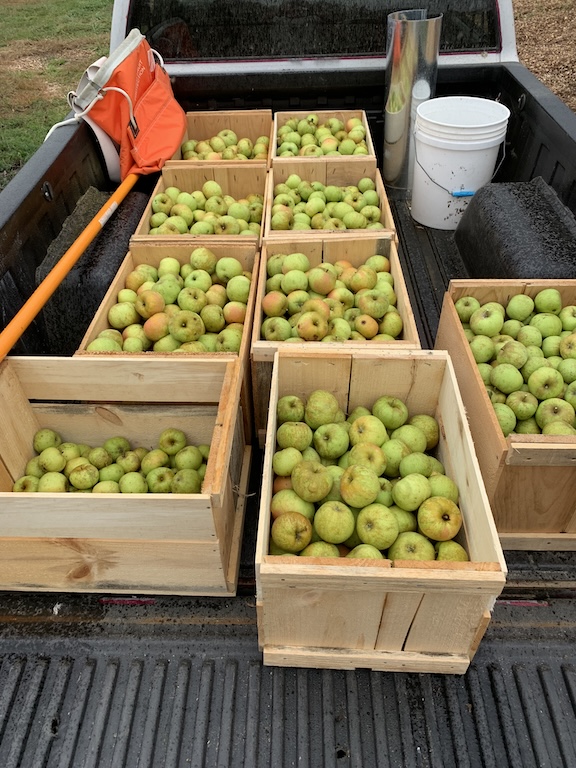
This spring marks 12 years since the first 101 apple trees were planted in the Maine Heritage Orchard (MHO) on a glorious April day with the help of dozens of dedicated volunteers. We’ve accomplished a great deal since that first planting day and continue our mission of preserving and educating about historic apple and pear varieties in the Northeast. We continue refining the collection through DNA profiling, gathering more data about the varieties and their performance in the orchard, and propagating apple and pear trees for dissemination to growers. In 2025, we celebrated the first year in which our harvest was bountiful enough to start selling fruit. I wanted to share these advancements to highlight the many facets of MOFGA’s orchard program, as well as to outline opportunities for community members to get involved, either through orchard events and workdays, or an orchard task where your skills can benefit the program. MHO was established as a volunteer-driven project and our volunteer outreach has waned a bit in recent years, but as the trees continue to grow and mature, so do the tasks to keep them healthy and to move the fruit into enthusiastic hands.
DNA Profiling
In 2019, we began collaborating with Washington State University to DNA-profile apple trees in MHO and the other two orchards on MOFGA’s campus to confirm the identities of individual trees and to help build the reference panel for the fruit genetics lab. If an existing orchard, like MHO, submits a sample saying “We know this to be Black Oxford” and it is not in the reference panel, then another orchard from another part of the country submits a Black Oxford sample and the DNA profiles match, that builds strong confidence that the DNA profile is actually Black Oxford. Three samples like this are the home run of confidence, as long as the orchards did not get the trees or scions from the same source.
To date, about two-thirds of the apple varieties in MHO have been profiled; our focus has been on the most rare and unique cultivars that have obscure histories. Results can take three to six months to receive, so the process can feel slow at times. There’s also a cost associated with sampling. Most of the trees remaining to be profiled are more common historic varieties that we feel confident about through phenotype identification — meaning the characteristics of the fruit in hand — and are therefore less of a priority. If you’re interested in learning more about DNA profiling of apples, visit myfruittree.org.
Bloom Records for Improved Pollination
One piece of seasonal data we strive to collect each spring is a blossom record to track when the various varieties are in bloom, helping us to understand which varieties bloom at the same time for better compatibility around pollination. That way we can make better recommendations to growers for an overlap in bloom, rather than having an early-blossoming variety like Crimson Beauty or Tetofsky planted with late bloomers like Bethel or Minister. These varieties seem to be at full bloom a week to 10 days apart and don’t have very good overlap for improved pollination. Tracking bloom is a pleasant task, but it is extremely time-consuming during May when so many other tasks need to be completed.
Harvest Time
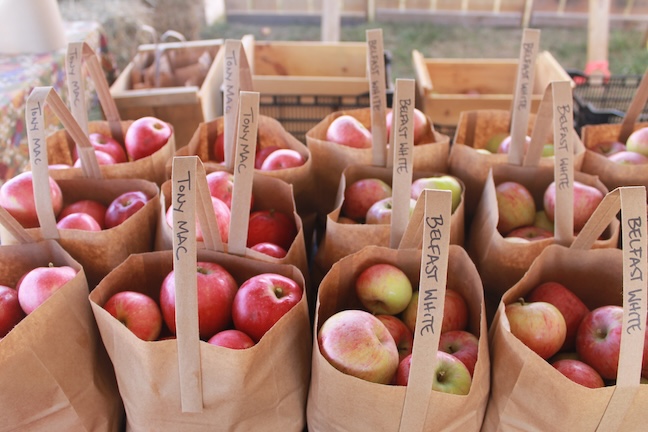
The MHO trees are starting to bear decent crops, and last fall we sold heritage fruit to a few local markets, as well as all weekend long at the Common Ground Country Fair. We plan to do the same this year, as these sales are truly key to our mission of education about these varieties. For years at the Fair, we have put together a fruit display of around 300 varieties for people to peruse and have held tastings where folks can try small samples, but now fairgoers can buy a handful of MHO fruit or take home 5-pound bags of various varieties to share with friends and family. It is our goal to make sure that every person leaves the MHO tent with at least one apple in their hand and discovers a new favorite, like Hayford, Belfast White, or Somerset of Maine.
On the other end of the season, we track harvest dates to know when fruit is ripening and ready to pick. This is much easier to manage compared to blossom data, and more fun since it involves a lot of taste testing, but the trees are getting to the point where harvesting the fruit is all-consuming. Last fall, for example, a 25-year-old apple tree on MOFGA’s campus yielded about 500 pounds of fruit, which took two people six hours to pick. Roughly speaking, 350 trees that each require 12 hours of harvest time comes to 4,200 hours of labor. That number may be a decade away, but we are already in need of harvest help, so stay tuned for opportunities this fall.
Another significant accomplishment in our fruit marketing is that we have received certified organic status for all fruit produced in MHO, including aronia and elderberry, from Baystate Organic Certifiers out of Massachusetts. We have always followed organic practices in MHO but could not be certified by MOFGA Certification Services (MCS) because of potential conflicts of interest. We have taken similar steps as all certified organic farmers do to document our production methods and to reassure our customers that we have been inspected and certified through this third-party verification process. We are happy to display the certified organic label with our fruit, and our certificate hangs on our office fridge as a daily reminder of the accomplishment.
Planting for the Future
In 2024, we transitioned one of the vegetable gardens by MOFGA’s farmhouse office into a nursery space for fruit tree propagation. We ran a medium-weight 8-foot-tall deer fence around the garden perimeter and fastened it to 10-foot-tall metal poles that were driven 2 feet into the ground. These were salvaged parts from scrapped tents damaged during events. We built three tree beds, 5 feet apart on center; amended the soil; and ran drip tape down the center of each bed. We currently have nearly 300 apple and pear trees in the nursery.
If you have been to our Seed Swap & Scion Exchange in recent years (which will be held this year on March 29), you may have noticed that we have been selling some of our extra heritage varieties from this nursery. This spring we are planning to sell many more varieties. In recent years, we have been able to dig trees from the nursery in late March, so our plan is to dig and wrap these trees just before the event. If the ground is still frozen, we will shift tree sale plans to coincide with our annual Earth Day Volunteer Workday on April 25.
2026 has been a challenging year for many people, but we always find peace in the orchard and comfort among the blossoming trees and ripening fruit. Our work in MHO continues with a focus on building and maintaining healthy soil to support the health of the trees, while also encouraging diversity throughout the orchard. If you are interested in helping, please keep an eye on MOFGA’s events and announcements for opportunities. We look forward to seeing you in the orchard.
As MOFGA’s orchard program manager, C.J. Walke cultivates all of the fruit trees on MOFGA’s campus, including the Maine Heritage Orchard. He strives to build healthy diversity in the orchard ecosystem, while sharing what he learns from the trees and the soil with other organic growers.
This article was originally published in the spring 2026 issue of The Maine Organic Farmer & Gardener.