
By Lea Camille Smith
Nerdy Turnip Farm, a MOFGA-certified organic operation in Rochester, New Hampshire, was born out of finding just the right space. In a difficult post-COVID market, Sam and Caleb Monohon happened upon a turnkey small farm operation in the middle of a residential area. “It was everything we had hoped for,” says Sam.
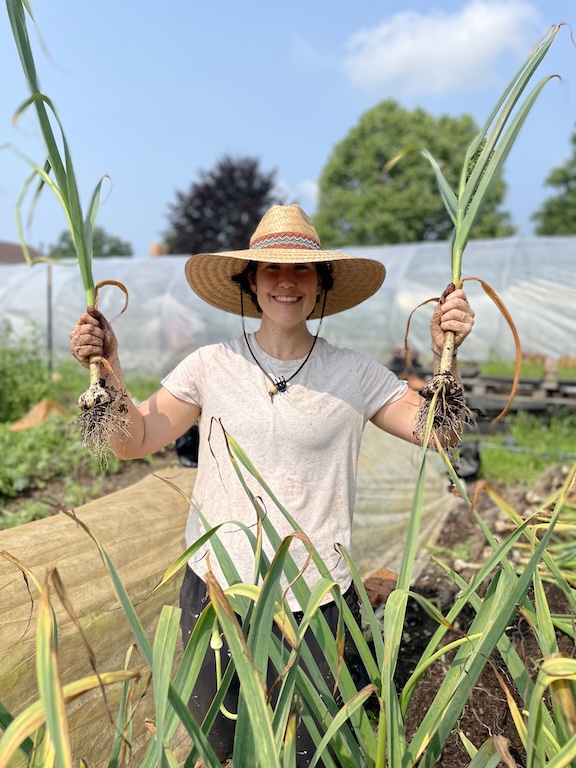
Though Sam is from Auburn, New Hampshire, and Caleb mostly grew up in Houston, Texas, the pair met in Colorado when Sam traveled west to obtain a master’s in education and work at an elementary school. This came after working on farms in the Northeast and teaching English as a second language. Soon after that, Sam returned to farming, then obtained a master’s in horticulture and soil microbiology. Caleb has worked in audio-visual installation for nearly 20 years but shared an interest with Sam in finding land to start a farm on.
In 2021, they moved back to New Hampshire with those hopes. They sought a rainier climate and a more robust local food scene than Colorado had to offer. The birth of their twins in 2022 brought a break in employment, during which they decided it was time to start their own farm operation.
In January of 2022, Sam and Caleb grew a large garden as they settled into the new property. During this time, Sam worked at another local farm. In 2023, they had their first official season selling products. In 2025, the had three employees, including Sam. Caleb works off the farm, but Sam notes that Caleb definitely “keeps everything working on the farm,” making sure equipment is fixed and maintained so Sam can continue doing what she loves: working with the soil and plants.
The farm name, Nerdy Turnip, came from a love of a specific plant — Hakurei turnips, a Japanese variety with a crisp flavor — and an interest in all things “nerdy.”
“Caleb is into Legos, ‘Lord of the Rings,’ ‘Harry Potter,’ board games, and all other forms of nerdy things,” says Sam. “I’m a nerd about plants, soil, food, and love school in any form. The nerdy piece of the farm is definitely a big part of our lives.”
Growing on just under a quarter acre of land, Nerdy Turnip Farm packs a punch with a wide variety of produce. It has been a balancing act for the farm to grow a diversity of crops for their community supported agriculture (CSA) members, while also maintaining consistent offerings for farmers’ markets, all in a small space. 2026 will bring an altered crop plan to help strike the balance.
Still, small-scale urban farming feels like a good fit for the Monohons. Sam enjoys the labor-intensive work that comes with human-powered farming. Additionally, they’ve experienced great sales, and their farm store thrived in 2025. Sam attributes the sales success to their urban setting ¾ it’s a convenient place for community members to stop by and purchase goods. Additionally, their area hasn’t had a farmers’ market for a few years, and Sam believes that there’s a deep need in the community for a local goods store. “People are really interested in what they’re eating,” says Sam. She adds, “A lot of our customers are excited to have a space where they can get organic, local food that’s close to home.”
However, there are a few drawbacks to doing all the work by hand, with their labor-intensive approach becoming a problem to solve if an injury or another limitation occurs within the small farm crew. These factors affect production, so Sam makes sure to ease mindfully into the season and work with proper body mechanics ¾ such as switching positions when doing tasks for long periods of time and using muscles instead of joints. She also takes note of bodily limitations to ensure everyone is working well through the whole season.
Sam takes their small farming space in stride as a unique and fun challenge to grow intensively in beds. She utilizes succession crops and intercropping strategies. But with the desire to integrate more cover crops within a limited space, they’re discovering more challenges. “I would love to use block crop rotation and cover cropping, but to miss out on cash cropping in an entire block at one time is tough to fit into our demanding production schedule.”
In addition to taking their small space into account, the farmers design their processes around bettering the land and community they live in. By taking a no-till approach, which they call “no-dig,” Sam enjoys the quiet of farming without tractors — and suspects her neighbors might, too. She says that they want to be “a welcomed and positive addition” to the neighborhood. “Keeping noise and emissions limited is something we strive for.”
Across the farm and beyond, the pair is trying to reduce fossil fuel use. Most of the farm is solar-powered, thanks to an 11.4-kilowatt system of 30 panels that cover the entire south-facing roof of the house.
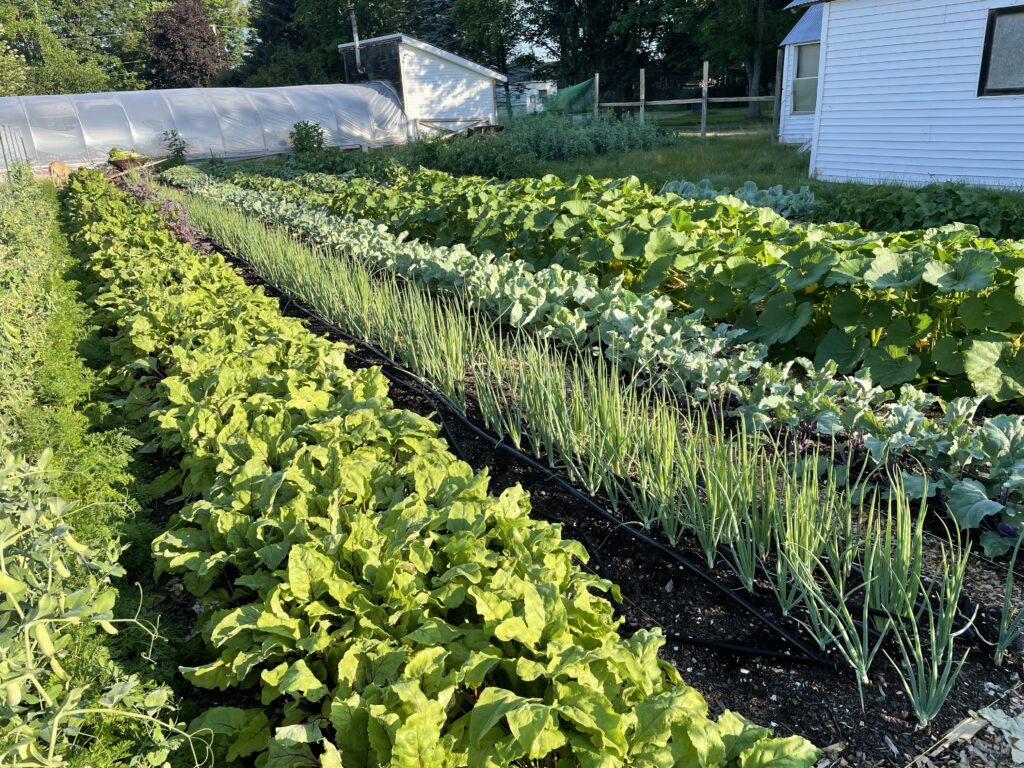
Their lawnmower, weedwhacker, and salad spinner, among other electric tools, are powered by the panels as well. Additionally, having only a quarter acre in production reduces the need for large machines. Because they use succession crops within an intercropped model, a traditional tillage process wouldn’t work.
“For example, a single bed can be lettuce heads with outer rows of onions in the spring. Come summer, those lettuce heads are harvested, those onions are untouched, and potatoes are planted down the center. We are able to be more precise with our crop plan because we use our hands to carry it out,” says Sam.
The no-dig approach aligns with the pair’s belief in the importance of soil health and microbes. Healthy soil supports crop immunity, nutrient uptake, and the ability to withstand climate stressors, while also supporting a nutrient-rich and delicious product.
In traditional tillage, soil microbes are disturbed. But when the microbes are not disturbed ¾ the case with a no-dig approach ¾ the microbes are ready to benefit the next crop. At Nerdy Turnip Farm, Sam and Caleb try their hardest to leave the “microbial communities” as uninterrupted as they can, ensuring future benefits.
For those looking to purchase organic produce grown with soil health in mind, Nerdy Turnip Farm offers multiple ways to find their offerings. They attend the Sanford Farmers’ Market and Candia Farmers Market; have a farm store on their property in Rochester; and offer a CSA. Their produce can also be found in dishes at MrSippy BBQ, Mana Kitchen, and Juniper Kitchen.
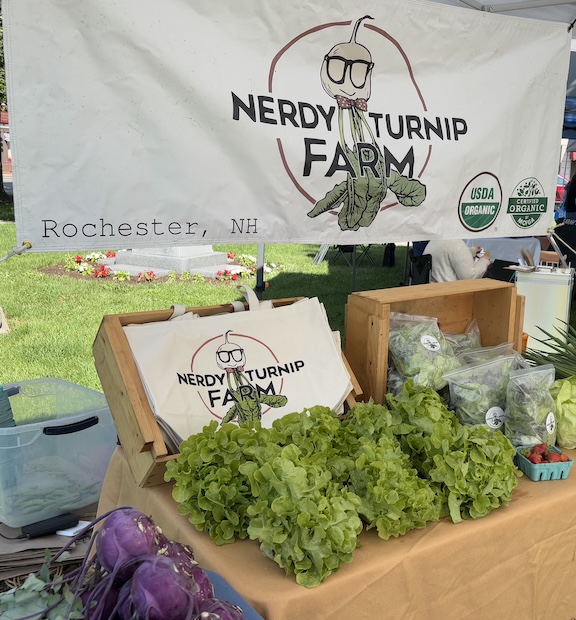
Beyond the crops, Sam and Caleb hope to leverage their urban setting and serve as a community educational hub, with agritourism opportunities and an expanded farm store where consumers can both buy products and learn about how their food is grown. To this end, the farm hosts a plant sale each spring and starts their seedlings at the beginning of the year. To make locally grown food more accessible in their area, their farm store already carries goods from other local farms and vendors. This provides a unique shopping opportunity that isn’t available anywhere else in their area. They also accept Supplemental Nutrition Assistance Program (SNAP) benefits at the farm store and for CSA shares, to reduce cost barriers for purchasing local food.
“Within our model of educating our community about food production, a piece of that is showing people how they can grow their own food, without machines, and without much space,” says Sam.
The pair is motivated by the hope of improving their community, the environment, and providing a life for their children that includes ample time outside along with the knowledge and appreciation of where their food comes from and how it’s grown. Engaging with the community and educating CSA members about what’s in their shares is also a huge plus. Sam and Caleb love food and all that goes into growing it.
When asked about her favorite crop, instead of the turnip, Sam chooses the tomato. “I love pruning and trellising tomatoes and getting covered in their sticky golden pollen.” She also loves growing scallions — and finds that they’re in high demand from customers — and delights in the wonder of pulling up a carrot or, of course, a turnip to see what has happened beneath the earth. Because the soil hasn’t been tilled for a few years, it can be tough to grow long, straight carrots, and they’ve harvested some fun and interesting shapes, which they sell as “creature carrot” bunches.
It is easy to think of farming as something only possible with lots of land, but Sam and Caleb have shown that a quarter of an acre can be maximized with patience, planning, and an understanding and appreciation of soil health and local food communities.
Lea Camille Smith is the editor for Edible New Hampshire and works in communications for food systems nonprofits. Her work can be found in the Tiger Moth Review, Island Ink, Mt Washington Valley Vibe, and elsewhere. She lives in New Hampshire.
This article was originally published in the spring 2026 issue of The Maine Organic Farmer & Gardener.