
By Jean English
Bambi Jones and David “Tracy” Moskovitz have spent half a century improving and enlarging their farm and forest land in Whitefield, Maine. Now they have a plan to use the special place they created to motivate one or more nonprofits to increase their impact. They have invited nonprofits to think creatively about how a gift of their property could move the organization to a new level. Another option for Jones and Moskovitz is to sell the farm to people who fit with the community and who will continue stewarding it; they will then donate the proceeds from the sale to one or more nonprofits.
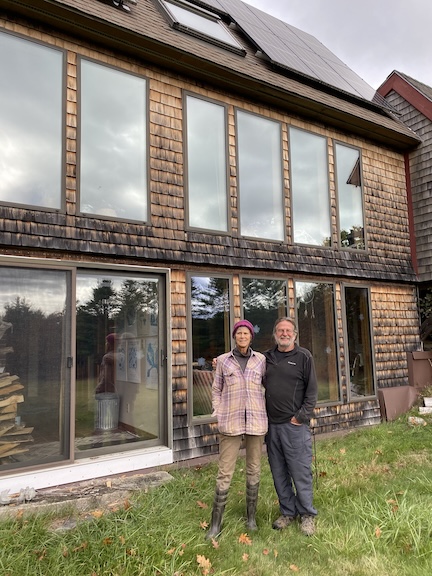
Back-to-the-Landers
Originally from Cleveland, the two went to the same elementary school but didn’t become a couple until they met again while working and going to school in Chicago. As the back-to-the-land movement blossomed in the ‘70s, they began thinking about relocating. After considering states in the Northwest and Northeast, they settled on Maine, where Jones had vacationed previously.
They bought 100 acres on a dirt road (Hollywood Boulevard) in Whitefield and established Hidden Valley Farm in 1978. Jones started one of the first CSA (community supported agriculture) farms in the state, growing MOFGA-certified organic vegetables for 120 members for more than a decade. Like most Maine farms, the land included a forest, from which the couple harvested timber for firewood and lumber to build their house and barn.
They continued buying land in Whitefield (and later in Jefferson and Alna), practicing sustainable forestry, creating trails for hiking and skiing, and improving wildlife habitat. In 2007, they and five neighbors, through Maine Farmland Trust (Jones served on its first board), put permanent easements on 1,000 of their combined acres — a testimony to the neighborliness of their area. Two other local properties were under easements before that, so now more than 90% of the land (about 1,500 acres) along Hollywood Boulevard is protected.
“I don’t know of any other place like this,” says Moskovitz. “It’s pretty special.”
“Community is very important to me,” says Jones. In addition to keeping their land open for neighbors’ use, they frequently join local friends for suppers and other activities.
By 2007, their land holdings exceeded 2,000 acres. From this, they created the nonprofit Hidden Valley Nature Center on 1,000 acres — Lincoln County’s largest private landholding open to the public — as a demonstration site for conservation and forestry practices that go beyond sustainable. Applying the “worst first” philosophy, they let the best trees continue to grow while harvesting others for firewood, pulpwood, and timber, thus creating space for and ensuring the health of the remaining trees. “I don’t think I’ve cut a good tree in 30 years,” Moskovitz told Mainebiz in 2014. “I’m not sure I know how.” They leave some dead trees for wildlife habitat.
In 2016, they sold Hidden Valley Nature Center at far below market value to Midcoast Conservancy, which continues practicing and teaching quality forestry and conservation methods as well as timber frame construction there.
Growing Hidden Valley Farm and Forest
Jones and Moskovitz retained their nearby 1,200 acres to continue farming and forestry on their Hidden Valley Farm and Forest. Although they’ve been harvesting trees for more than 40 years, their land is better stocked and more productive than when they bought it.
“Our forest management is really aimed at long term,” says Moskovitz in a video produced by the Sand County Foundation. “We’ve always managed our woods to increase the health and quality and quantity of wood that’s here. So even though we’ve been harvesting continually, there’s a lot more wood on the land today than there was when we bought it. And the wood is of much higher quality.”
Neighbors and friends use the more than 25 miles of logging roads and trails on this land, all maintained, labeled and mapped, for hiking, skiing, biking, and horseback riding. “We’re happy to see our neighbors, our friends” enjoy the land, says Jones. Their trails connect with those at Hidden Valley Nature Center.
Through their land purchases over time, the couple has helped reverse the trend of forest fragmentation, thus supporting wildlife habitat and biodiversity. Most of their land is within a wildlife sanctuary designated by the state of Maine.
Because of their efforts, they received the 2014 Regional Outstanding Tree Farmers of the Year award for the Northeast region of the American Tree Farm System, the 2017 Cooperator of the Year Award from the Knox-Lincoln Soil and Water Conservation District, and the 2024 Leopold Conservation Award for New England from the Sand County Foundation — the first Mainers to win that award, which is named for writer and conservationist Aldo Leopold. The Leopold award was presented by the Sand County Foundation and the New England Forestry Foundation and was sponsored by American Farmland Trust.
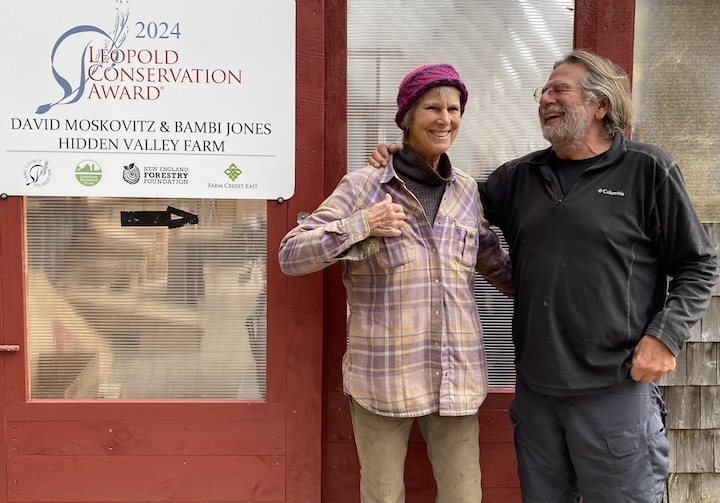
Cultivating for the Future
Now in their 70s and having cherished and worked their land for almost 50 years, Jones and Moskovitz are thinking about the future of their Hidden Valley Farm and Forest. They are considering donating the approximately 1,200 acres (most of it contiguous), buildings, and farm and forestry equipment, all informally appraised at $4 to $5 million, to a conservation organization or to a partnership of two or more organizations — along with a significant endowment. Or they could sell it to a conservation-minded buyer —”maybe someone in the MOFGA community,” they say — and donate the proceeds to one or more nonprofits.
“We’re flexible,” says Moskovitz, adding that the donation will probably be phased in over five or so years. They can protect the property through easements so that its care remains true to their practices and to limit its development and/or subdivision. Currently 700 acres are under such an easement donated to Maine Farmland Trust. They will probably enroll the rest in that easement program.
Soliciting Proposals
In early 2025, they contacted groups they thought might be interested in the property and received several proposals. Their top priority is how the donation will make the selected organization more impactful.
“To our knowledge,” say Jones and Moskovitz, “this is the largest contiguous property under single ownership in Midcoast Maine.” It includes about 10 acres of land that was MOFGA-certified organic for 35 years and supported significant production of vegetables and hay. (Jones recently dropped the certification since she no longer sells vegetables.) Their land abuts another 537-acre woodlot, the owner of which is also interested in conservation opportunities.
Most of their land is enrolled in Maine’s Tree Growth program, which saves on taxes. (The state pays the town the difference between the market value of the land and the tree growth value.)
Jones and Moskovitz are enthusiastic about increasing the support forestry can provide Maine farms. “In Europe, forests are an asset,” says Moskovitz. “Most of the farms protected by Maine Farmland Trust are at least partially or significantly forested,” but the landowners often don’t take advantage of their woodlands. He notes that the New England Forestry Foundation, through its Pooled Timber Income Fund, can manage land and provide nonprofits or private landowners with a steady stream of income.
The homestead part of their land consists of about 5 acres. Buildings include their 2,550-square-foot earth-bermed passive solar home that has been featured in national magazines and has a stone patio, two decks, and an enclosed porch; a two-story barn with a solar system; a 24-by-48-foot greenhouse with a concrete floor, insulated north wall, water-based heat storage, and a mounted propane heater; a hoophouse; four large storage sheds; a root cellar; two cabins; a 28-foot-diameter hexagon; and a 17-by-34-foot post and beam off-grid cabin with solar power on Little Dyer Pond.
Farm equipment includes five tractors; a cut-to-length tree harvester; a forwarder, bulldozer, and excavator; equipment for haying, tilling, and mowing; and more.
They hope to decide on a donee or buyer by summer 2026 if they get a proposal that they like. They evaluate proposals based on how their gift will make the organization more impactful; how the gift will change, redirect, or help fulfill the organization’s mission; how it will change the long-term financial health of the organization; whether it leverages other possible donations; and whether it is consistent with and supports the local community. They will also consider whether the staff and board are committed to the proposal, and the ability and track record of the organization to deliver on plans.
They want the property to be permanently protected and preferably to remain intact and under single ownership. Sustainable forestry should continue on most of the property, while agricultural, educational, and recreational uses are pluses. They care about the potential owner organization’s community engagement and connection to the property. They hope proposals will demonstrate new economically viable business models that support conservation, that other conservation organizations can follow and that inspire other landowners.
Interested parties can contact Jones and Moskovitz at [email protected].
Jean English is a retired editor of The MOF&G. She lives in Lincolnville, Maine.
This article was originally published in the spring 2026 issue of The Maine Organic Farmer & Gardener.