

Pest: Allium Leafminer (Phytomyza gymnostoma)
First detected in the United States in Pennsylvania in 2015, Allium leafminer (Phytomyza gymnostoma) is a potential threat to all crops in the allium genus. Since its first detection, allium leafminer has rapidly spread throughout the Northeastern United States. Every growing season seems to bring sightings at new locations, so it is likely more a question of “when” than “if” this pest will show up near you.

Pest Identification and Lifecycle:
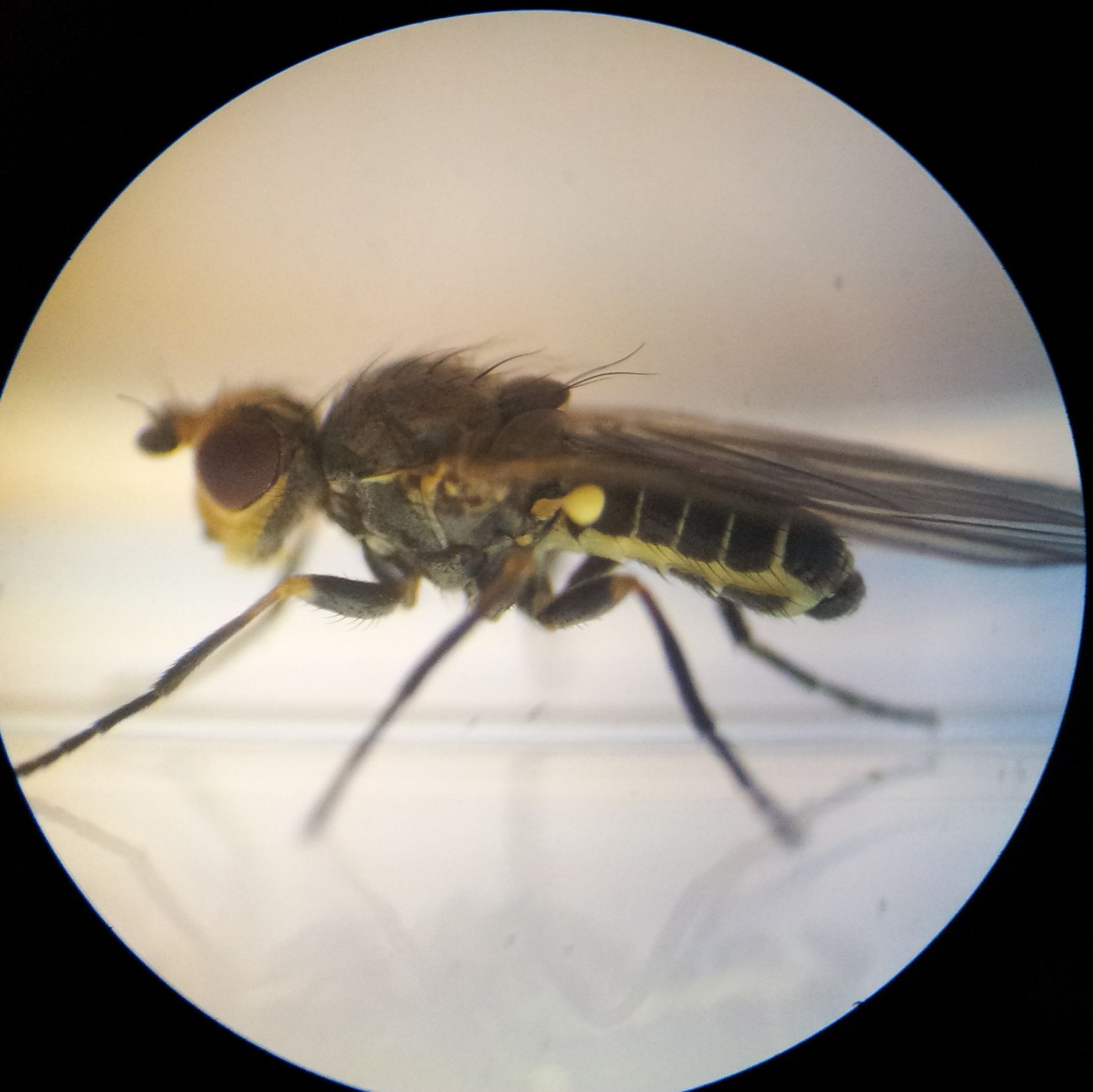
Allium leafminer is an invasive pest of allium crops (onions, scallions, leeks, etc.) Adult allium leafminers are small gray/black flies (less than one-eighth inch) with an orange/yellow spot on the tops of their heads, and yellow “knees” (Fig. 1). Their eggs are small, white, and slightly curved and require magnification to see. The allium leafminer larvae (maggots) are more visible, growing to be about a third of an inch long, and white to yellowish in color. Pupae are red to dark brown and about one-eighth of an inch long.
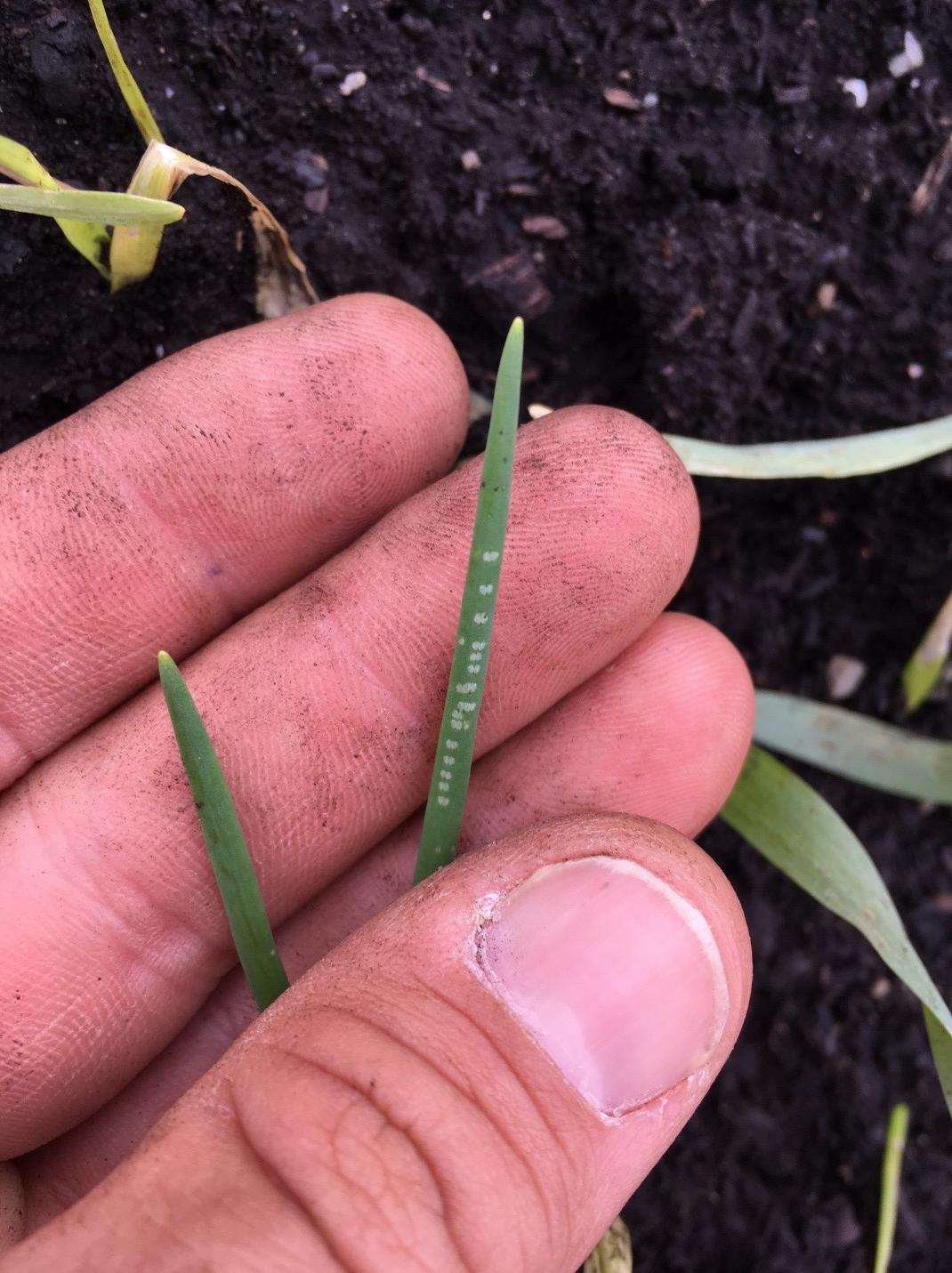
Allium leafminers have two generations in a year. Adults emerge in late winter through early spring (March and April) after overwintering as pupae in host crop debris, or the soil immediately surrounding it. After mating, adults seek out host plants to lay eggs into. These first-generation eggs hatch out as larvae, which “mine” the inner leaf surfaces, moving downward towards the leaf base, or bulb. They then pupate in that plant tissue (Fig. 2), or in the soil surrounding it. This is the life stage in which they remain dormant through the summer, emerging as adults in late summer or early autumn (typically in early September). Those adults quickly begin to lay a second generation of eggs into the leaves of various alliums, whose larvae will once again mine the leaves of these plants. This second generation of allium leafminer larvae become the next overwintering generation, pupating inside crop tissues, or in the soil immediately surrounding them.
Damage and crops affected:
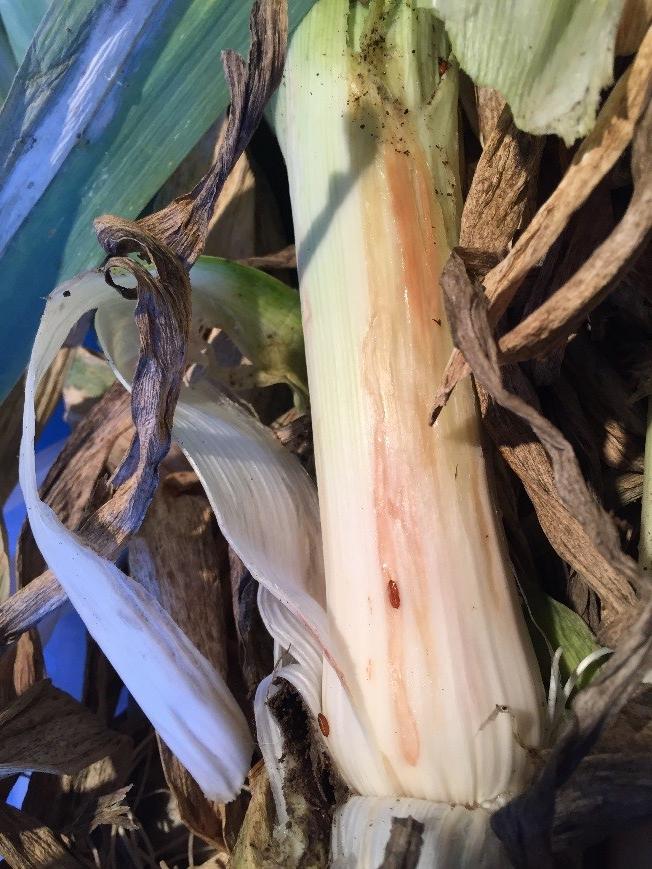
The second generation of allium leafminer is often the most damaging to crops, both because the population is typically much larger than in the first generation, and because the presence of larvae, their feeding damage, or pupae can greatly impact the salability of crops that are present at that time. Allium leafminer can infest any species in the genus Allium, including onion, garlic, shallot, green onion, chives, and ornamental and wild alliums. Initial damage symptoms are caused by the adult flies as they leave distinctive white circles caused by their ovipositors (egg-laying appendages) puncturing the leaf surface (Fig. 2). While this ovipositing is how they lay eggs under the surface of the leaf, this damage also allows adult flies to easily feed on plant sap and not all oviposition marks will contain eggs. After larvae hatch from the eggs and begin feeding within the leaf, classic leaf mining damage appears as white tunnels and galleries spreading under the outer surface of the leaf, and larvae often move downwards towards the leaf base or into the bulb. In addition to impacts on crop photosynthetic capacity, and potentially significant cosmetic injury, severe infestation may provide enough larval feeding to cause distorted growth or even plant death. Both the oviposition punctures and subsequent leaf mining wounds (Fig. 3) create potential entry points for fungal and bacterial pathogens, which can be as, or more, damaging as the leafminers. Direct damage to bulb crops is less of a concern from this pest.
Allium leafminer damage symptoms are identical from both spring and fall generations, however, the crop species and growth stages present at those times can result in different risk scenarios. Adult flies are attracted to larger leaves to lay eggs into. Because of this, spring egg laying by the overwintered generation is more likely to occur on plants that typically have larger leaves at this time; perennial species like chives or ornamental alliums, wild species like ramps, and overwintered annuals like garlic or overwintered onions. Recently transplanted, or direct seeded onions, leeks, scallions, etc., may still have leaves small enough to be less attractive to the adult flies. When the first-generation adults begin to fly and seek egg-laying host plants, most garlic and onion crops will have already been harvested, and many ornamental or wild species will have gone dormant for the year. With this reduction in presence of host species, any remaining allium leaves will be at a greater risk from what may be an even larger second generation. Leeks, scallions, chives, and any other allium with healthy green leaves are at the greatest risk at this time.
Management Options
Scouting
Inspect any bought-in allium plants and bulbs for signs of infestation — particularly the presence of pupae — before planting them. However, the adult flies are mobile, and while not long-distance fliers, it appears that the pest is spreading quite competently on its own, without purchase of infested planting stock as a necessary means for its arrival.
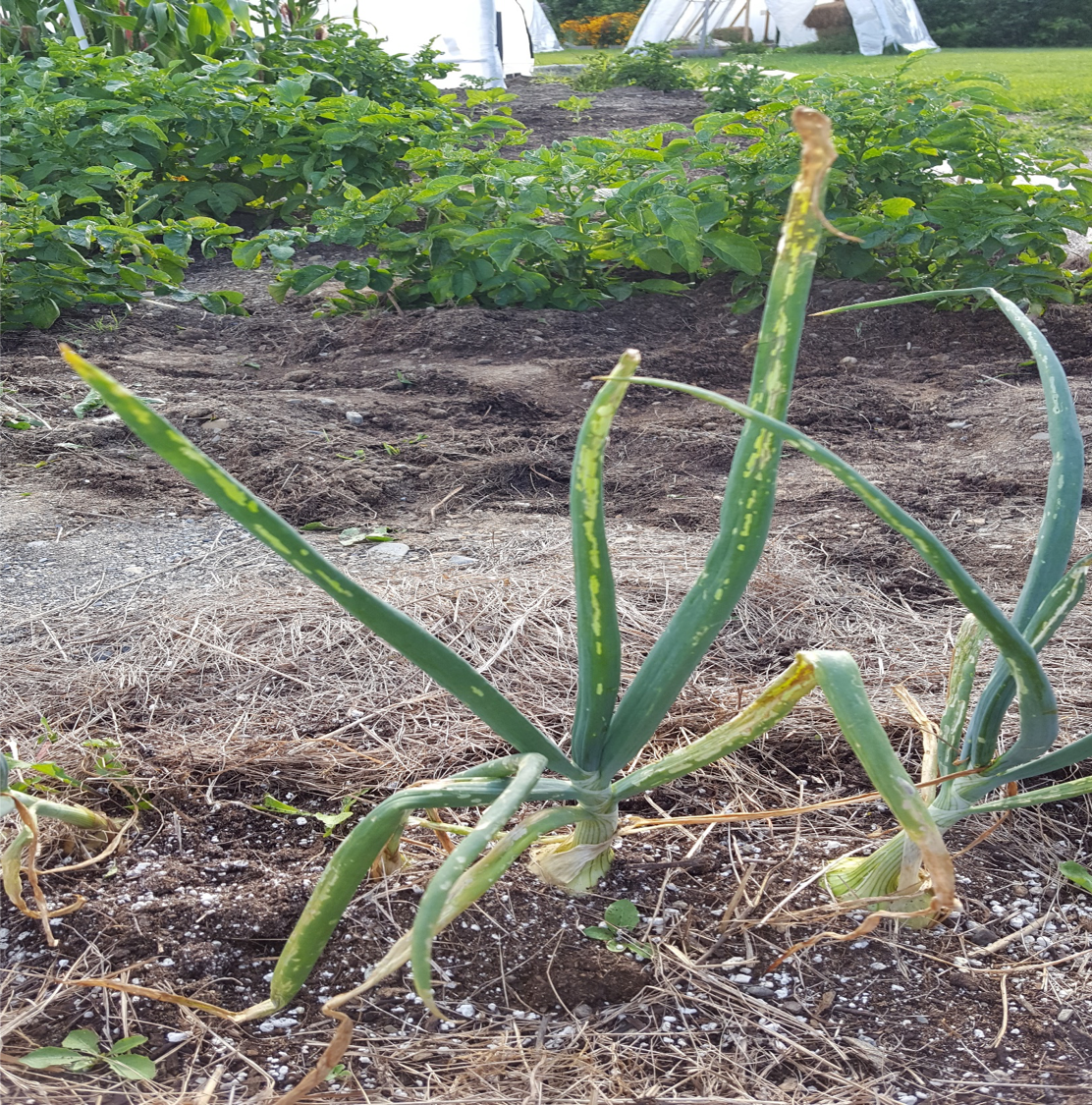
To monitor for allium leafminers, scout for their telltale oviposition/feeding damage — repeated punctures in allium leaves. This typically occurs starting in late March through April in the Northeast. Following that, larval leaf mining may be visible, though take note that in tubular-leaved species like onions, scallions, and chives leaf mining under the leaf surface could perhaps be confused with “windowpane” feeding damage (Fig. 4) from leek moth caterpillars (the presence of that invasive pest may be just as concerning, or even more so!). While adult allium leafminer flies can be found on yellow sticky cards, the damage they cause to allium leaves is likely to be more easily noticed by the untrained eye.
Though overall damage is typically worst from the second generation of this pest in fall crops, especially leeks, overwintered onions, perennial chives, and early scallions may provide ideal springtime scouting sites to observe the arrival of this new invasive pest. There is evidence that allium leafminers prefer chives to scallions, onions, and leeks. Recent observations have reduced confidence in the reliability of this, however, early research had indicated that overwintered adult allium leafminer flies emerge when growing degree day (base 1 C, or 33.8 F) accumulation reaches 350. Around that time, adult allium leafminers emerge, mate, and begin ovipositing — the most obvious sign of their presence — and may continue to do so for several weeks following.
You can quickly see the growing degree day (GDD) accumulation in your area with maps provided by the Maine Climate Office, including one calculated on a base 33.8 F which is equivalent to 1 C, this page of GDD maps for Maine. You can also find the closest weather station to you at The Network for Environment and Weather Applications (NEWA) to view current GDD accumulationin your area, as well as the expected accumulation in the coming six days.GDD accumulation is calculated starting at the beginning of the calendar year (January 1) and you may need to input the current date as the “end date” of the calculation. Be sure that the calculator is set to a base temperature of 1 C.
Cultural
Crop rotation combined with row cover or exclusion netting is typically the most effective organic method to reliably achieve the greatest crop protection from flying pests. For this strategy to work, attention must be paid to the location where the prior season’s second generation of allium leafminer pupae are most likely to have overwintered. Pupae will be found in living or dead crop tissue, or the soil immediately surrounding it. This could include wild or planted perennial allium locations, a field where annual alliums were grown in the prior year, or even a cull pile where infested crop debris was not destroyed or sufficiently buried. To exclude adult allium leafminers from laying eggs in new plantings, they must be covered before the emergence of adults from the overwintered generation. Covering fall plantings to prevent first-generation adults from laying eggs for the second generation may also be effective if done before late August when adults may begin to emerge. Fall emergence and egg laying is thought to occur for a more prolonged period of time than in the spring.
Careful timing of planting and harvesting susceptible crops, combined with exclusion is likely to provide satisfactory control for most growers that are of a small enough scale to easily cover plantings. Reflective plastic mulch may also reduce damage somewhat. Removal and destruction, deep tillage, or deep burial of crop debris will help to reduce the amount of overwintering pupae emerging the following spring.
Biocontrol
There are no known commercially available effective biocontrols at this time. Shortly after allium leafminer was first detected in Pennsylvania, researchers there identified some very low rates of parasitism from two species of wild parasitoid wasps (Halticoptera circulus and Chrysocharis oscinidis). More parasitoid species are known to attack allium leafminer in its native Europe, and reports from there are of its greatest damage potential being in the first few years after it shows up in an area as a new pest, suggesting that natural enemies native to the continent likely played a significant role in keeping its population to levels of lesser concern. There may be some hope of native or introduced predator and parasitoid species controlling populations of this pest in the future, but as of now that should not be counted on to occur for some time, if at all.
Pesticides
Field trials performed by Cornell Cooperative Extension have found that three applications, spaced seven to ten days apart, of two spray mixes, to be the most impactful for controlling the most damaging fall flight of the allium leafminer, especially as the adults have a prolonged emergence window. The most effective spray program they identified was to apply, two weeks after the fall flight begins, a mixture containing a pyrethrin (e.g., PyGanic) and an azadirachtin product (e.g., AzaGuard, or many other options). Be aware that this mixture loses efficacy drastically when the final mixture pH is neutral or above. Ideally the water used should have a pH between 5.5 and 6.5, and it is best to avoid adjuvants that may raise pH, such as M-Pede. A more appropriate adjuvant for this tank mixture would be OROBOOST at a 0.25% concentration (by volume). That was followed by the first of two applications of a spinosad product (e.g., Entrust) at a rate of 6 oz./acre, mixed with a 1-5% solution (by volume) of M-Pede, which improved contact and therefore efficacy of the spinosad product.
Please note: This information is for educational purposes. Any reference to commercial products, trade or brand names is for information only, and no endorsement or approval is intended. Pesticide registration status, approval for use in organic production and other aspects of labeling may change after the date of this writing. It is always best practice to check on a pesticide’s registration status with your state’s board of pesticide control, and for certified organic commercial producers to update their certification specialist if they are planning to use a material that is not already listed on their organic system plan. The use of any pesticide material, even those approved for use in organic production, carries risk — be sure to read and follow all label instructions. The label is the law. Pesticides labeled for home garden use are often not allowed for use in commercial production unless stated as such on the label.
Sources
Written by Caleb Goossen.